
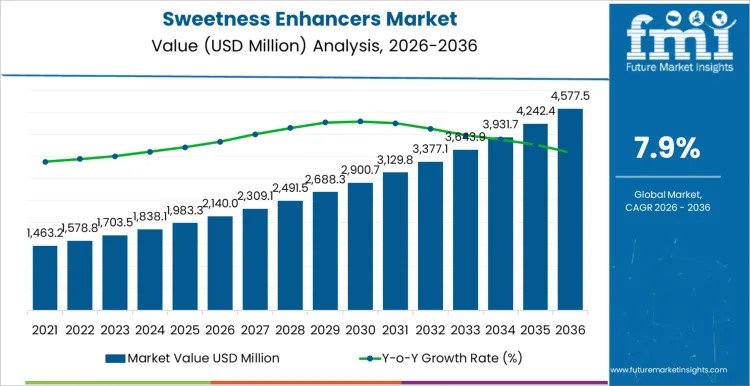
Global sweetness enhancers market grows at 7.9% CAGR through 2036 as food and beverage reformulation accelerates worldwide.
NEWARK, DE, UNITED STATES, January 16, 2026 /EINPresswire.com/ — The global sweetness enhancers market is projected to reach a value of USD 2,140.0 million in 2026 and expand to USD 4,577.5 million by 2036, advancing at a compound annual growth rate (CAGR) of 7.9% over the forecast period. Growth is driven by sustained reformulation activity across beverages, dairy products, confectionery, baked goods, and functional foods, as manufacturers reduce added sugar while maintaining established taste profiles.
Sweetness enhancers are formulation ingredients designed to amplify perceived sweetness intensity and improve temporal balance when sugar content is lowered. Their use has become central to reformulation strategies rather than an optional flavor adjustment, particularly as regulatory frameworks and labeling requirements place greater emphasis on added sugar disclosure.
Explore comprehensive market trends, regional outlooks, and competitive intelligence Get a Sample Copy Now – https://www.futuremarketinsights.com/reports/sample/rep-gb-31440
Market Context: Why Sweetness Enhancers Matter
Food and beverage producers face a persistent challenge: reducing sugar without compromising taste, mouthfeel, and consumer acceptance. Sugar plays a structural and sensory role beyond sweetness, influencing browning, aroma release, and flavor perception. When sugar levels are reduced, products often exhibit flat or imbalanced taste profiles.
Sweetness enhancers address this gap by strengthening sweetness perception and smoothing onset and linger, especially when paired with high-intensity sweeteners such as stevia, sucralose, monk fruit, or aspartame. Beverage producers rely on these systems to preserve sweetness roundness in carbonated soft drinks, flavored waters, and functional beverages. Bakery and snack manufacturers apply enhancers to offset flavor dilution caused by reduced sucrose during thermal processing.
Key Market Metrics and Outlook
• Market value (2026): USD 2,140.0 million
• Forecast value (2036): USD 4,577.5 million
• CAGR (2026–2036): 7.9%
• Leading product type: High-intensity sweetness enhancers
• Fastest-growing countries: India, China, Brazil, United States, United Kingdom
Demand growth reflects reformulation depth rather than overall food volume expansion, positioning sweetness enhancers as efficiency tools within sugar-reduction programs.
Product Type Trends: Performance and Label Balance
High-intensity sweetness enhancers account for 36.0% of global demand, reflecting their effectiveness at low inclusion levels and minimal caloric contribution. Natural sweetness enhancers follow closely at 34.0%, selected where clean-label positioning and plant-based sourcing influence formulation strategy. Synthetic sweetness enhancers represent 20.0% of demand, valued for cost efficiency and consistent performance in large-scale manufacturing. Other enhancer types, accounting for 10.0%, serve specialized sensory requirements.
This distribution highlights a balanced market where performance-driven solutions coexist with label-conscious alternatives.
Application Analysis: Beverages Lead Adoption
Beverages represent the largest application segment at 38.0% of global demand. Reformulation of soft drinks, flavored waters, and functional beverages continues to drive adoption as manufacturers seek to maintain sweetness familiarity under reduced sugar conditions.
Bakery and confectionery applications account for 21.0%, requiring enhancers that withstand heat while preserving sweetness perception. Dairy products represent 17.0%, focused on flavor balance in yogurts and flavored milk. Processed foods contribute 14.0%, while pharmaceuticals and nutraceuticals account for 10.0%, where enhancers improve palatability of bitter actives and fortified formulations.
Form Preferences: Liquids Dominate Industrial Use
Liquid sweetness enhancers hold a 44.0% share due to ease of dosing, rapid dispersion, and suitability for beverage systems. Powder forms represent 41.0%, favored in dry mixes and baked goods. Granular formats, at 15.0%, are used where controlled handling or release characteristics are required. Selection is driven by manufacturing process, dosing precision, and storage stability.
Regional Growth: Reformulation Intensity Drives Demand
Asia Pacific leads global growth, with India recording a CAGR of 9.4% and China 9.1%. In India, demand is supported by reformulation across beverages, flavored dairy, syrups, and fortified foods, where cost optimization and heat stability are critical. China’s growth reflects large-scale beverage and dairy reformulation aligned with national sugar intake guidance.
Brazil posts an 8.7% CAGR as nutrition labeling requirements reshape beverage formulations, while the United States grows at 7.6% amid portfolio-wide sugar reduction strategies and added sugar disclosure. The United Kingdom records a 7.4% CAGR, driven by sugar levies, retailer nutrition standards, and clean-label requirements.
Competitive Landscape: Sensory Reliability as Differentiator
The competitive landscape is shaped by ingredient suppliers supporting long-term reformulation programs. Key players include Ingredion, Tate & Lyle, Cargill, ADM, and DSM-Firmenich. Competitive differentiation centers on sweetness amplification efficiency, regulatory coverage, formulation adaptability, and sensory validation capabilities. Buyers prioritize suppliers offering application testing, consistency across processing conditions, and compatibility with existing flavor and texture systems.
Complete Market Report Ready for Access : https://www.futuremarketinsights.com/checkout/31440
Outlook Through 2036
As regulatory scrutiny of sugar content continues and consumer expectations for taste remain unchanged, sweetness enhancers are expected to remain central to global reformulation strategies. Market expansion will be driven by sensory performance, processing reliability, and the ability to support sugar reduction without compromising product identity.
Why FMI: https://www.futuremarketinsights.com/why-fmi
Related Insights from Future Market Insights (FMI)
Guacamole Market: https://www.futuremarketinsights.com/reports/guacamole-market
Deli Meat Market: https://www.futuremarketinsights.com/reports/deli-meat-market
Health and Wellness Foods Market: https://www.futuremarketinsights.com/reports/health-and-wellness-foods-market
About Future Market Insights (FMI)
Future Market Insights, Inc. (FMI) is an ESOMAR-certified, ISO 9001:2015 market research and consulting organization, trusted by Fortune 500 clients and global enterprises. With operations in the U.S., UK, India, and Dubai, FMI provides data-backed insights and strategic intelligence across 30+ industries and 1200 markets worldwide.
Sudip Saha
Future Market Insights Inc.
+1 347-918-3531
email us here
Legal Disclaimer:
EIN Presswire provides this news content “as is” without warranty of any kind. We do not accept any responsibility or liability
for the accuracy, content, images, videos, licenses, completeness, legality, or reliability of the information contained in this
article. If you have any complaints or copyright issues related to this article, kindly contact the author above.
